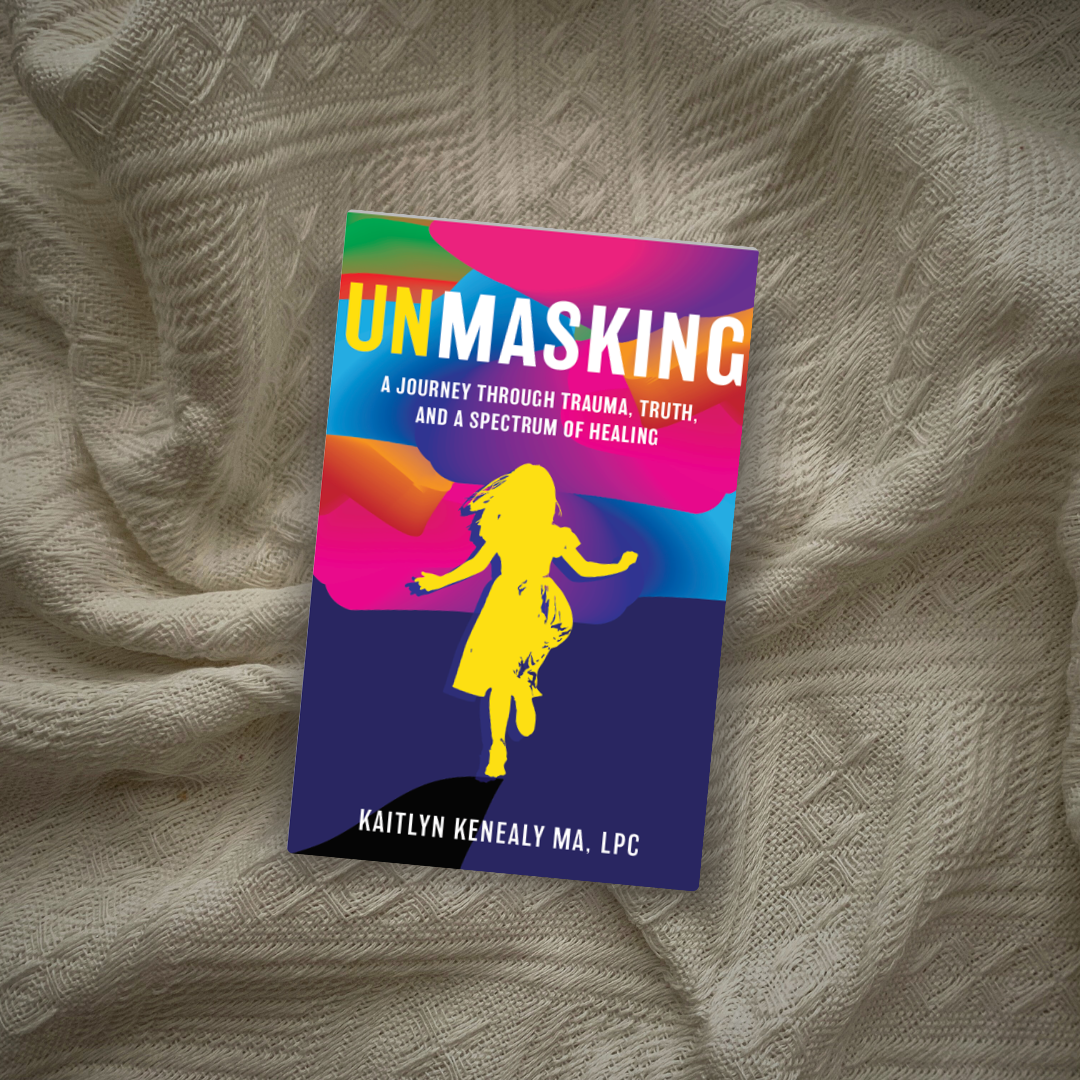

We’re thrilled to celebrate the launch of Unmasking: A Journey Through Trauma, Truth, and a Spectrum of Healing by Kaitlyn Kenealy, MA, LPC—author, psychotherapist, and CEO of Into the Woods Wellness. We sat down with Kaitlyn to talk about what inspired Unmasking, the meaning behind its title, and what she hopes readers will take away from her story
What inspired you to write Unmasking, and why now?
This book came from a very different place than my first one.
Healing Is Messy AF was written while I was still actively surviving and trying to make sense of trauma in real time. Unmasking came after years of living with that awareness. I finally had enough distance—and enough honesty—to look back and recognize how much of myself I had been carrying quietly. It felt like a coming-of-age moment in adulthood, where I could name who I was becoming, not just what I had lived through. Almost as soon as I finished this book, I began writing the next one, which made it clear this wasn’t a standalone story—it’s a series that’s still unfolding.
The title Unmasking is powerful. What does “unmasking” mean to you, both personally and professionally?
Personally, unmasking has meant loosening the identities I learned to wear to stay safe—the strong one, the high achiever, the caretaker. Those roles helped me survive, but they also kept parts of me hidden. Professionally, unmasking is a commitment to authenticity in healing. I believe people heal most deeply when they don’t have to perform wellness, when they’re allowed to be human, complex, and real.
You describe this as a journey through trauma, truth, and healing. Can you walk us through what that journey looked like for you?
Trauma shaped my early life long before I had language for it. Truth came later, and it came slowly—through therapy, grief, leadership, and moments where I could no longer bypass what my body was holding. Healing didn’t arrive as a big breakthrough; it showed up as a series of quiet recognitions. This book follows that rhythm honestly: the unraveling, the resistance, the pauses, and the gentle returns to myself.
As both a psychotherapist and someone who has navigated your own healing journey, how has your personal experience shaped the way you work with clients?
It’s made me far more attuned and far less rigid. I don’t sit across from clients as someone who has it all figured out—I sit with them as someone who understands how nonlinear and personal healing really is. My own journey reinforced that safety, pacing, and nervous system regulation matter just as much as insight. Healing happens in relationship, not in performance.
What does “a spectrum of healing” mean, and why is it important to understand healing this way?
For me, a spectrum of healing is deeply connected to my neurodiversity. I don’t experience emotions, regulation, or processing in a linear or predictable way—and many people don’t, even if they don’t yet have language for it. Healing on a spectrum honors that our nervous systems, brains, and lived experiences are all different. Some days I feel integrated and grounded; other days something old gets stirred and I have to meet myself there again. Understanding healing this way removes shame and allows growth and tenderness to coexist. It also challenges the idea that healing looks the same for everyone—or that it ever truly ends.
What are some of the biggest misconceptions people have about trauma and trauma recovery?
One major misconception is that trauma only counts if something “big enough” happened. Often, trauma is about what was missing—safety, consistency, attunement. Another misconception is that healing should look calm and resolved. In reality, healing can be uncomfortable, emotional, and deeply human. That doesn’t mean it isn’t working.
Were there any challenging moments in writing this book?
This book took many years to write, and it was one of the most difficult things I’ve ever done. I had to revisit wounds I genuinely believed were healed—only to realize they had simply been quiet. Writing required me not just to feel those experiences again, but to explain them, contextualize them, and shape them into a story people could understand or want to read. Holding the emotional truth, the clinical understanding, and the responsibility of storytelling all at once was incredibly complex. There were moments I questioned whether I could—or should—keep going. But telling the truth mattered more than staying comfortable.
What do you hope readers—whether they’re therapists, trauma survivors, or both, take away from Unmasking?
I hope readers feel less alone in their inner world. I hope therapists feel permission to honor their humanity, and survivors feel validated in their pace and process. Most of all, I hope people walk away knowing that healing isn’t about becoming someone new—it’s about coming home to who you were before the world taught you to hide.
As the CEO of Into the Woods Wellness, how does your work there reflect the principles and insights you share in the book?
Into the Woods Wellness reflects the same values that live in Unmasking: integration, compassion, and safety. We focus on whole-person care—mental health, physical wellness, nutrition, mindfulness, and community—because healing doesn’t happen in isolation. The organization mirrors my belief that people heal best when they feel supported, not pushed.
What advice would you give to someone who is just beginning their own journey of unmasking and healing?
You don’t have to take the mask off all at once. Start by noticing where you feel safest telling the truth—even if that truth is only to yourself. Healing doesn’t require bravery every day; sometimes it just requires gentleness and patience.
What’s next? Do you have more book ideas in you?
Yes—and I’ve already started the next book. Unmasking is intentionally part of a series, and the story continues. This book feels like the coming-of-age chapter—the moment where awareness meets truth. The next book moves further into embodiment and integration, exploring what it actually looks like to live unmasked. The series is growing alongside me, in real time.
Want to explore the book for your own healing journey?
Grab a pre-order copy today and use promo code: UNMASKING for a discount.